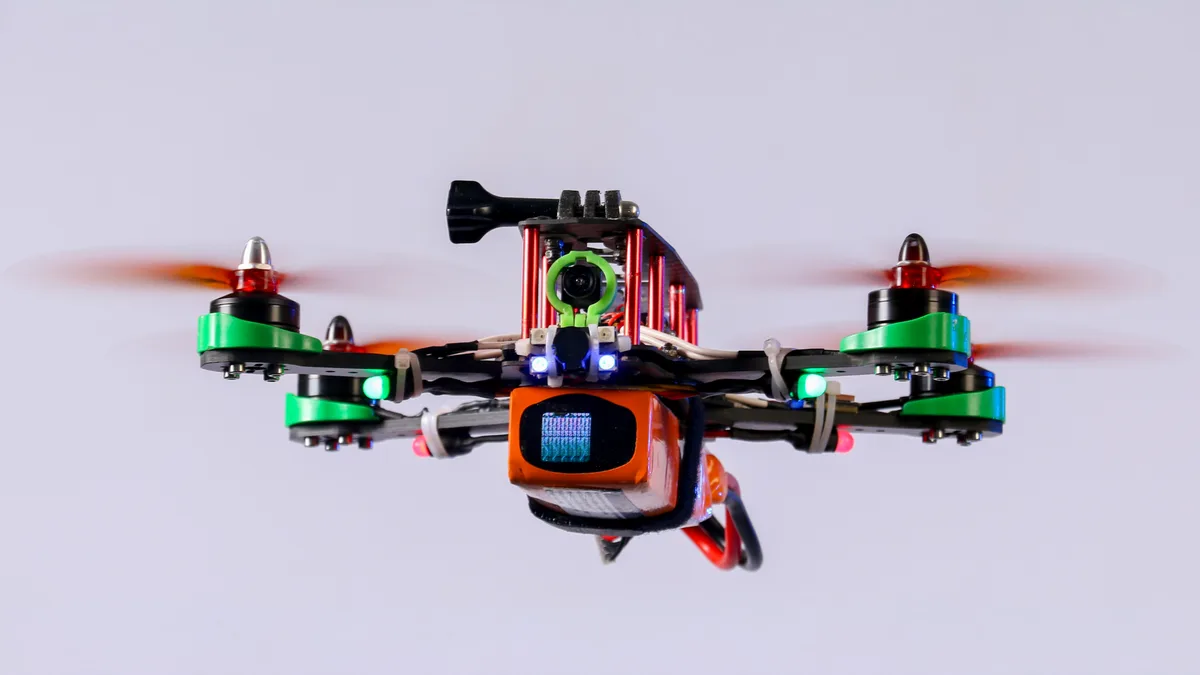
Cinewhoop
| Type | FPV drone |
|---|---|
| Original use | Cinematic indoor and proximity flight |
| Size class | Tiny Whoop |
| Prop guard | Integrated ducted design |
| Frame material | Carbon fiber and plastic |
| Camera mount | Typically protected within the ducted frame |
| Flight style | Acrobatic and precise |
Origin and history
The Cinewhoop drone originated from the First-Person View (FPV) racing and freestyle community in the late 2010s. It emerged as a distinct airframe class primarily from DIY builder experimentation rather than a single corporate invention. Pilots sought to adapt agile, small-form-factor quadcopters for safer, closer proximity filming by adding protective ducts. This development was heavily influenced by the rise of digital FPV video systems, which provided the stable, high-quality footage necessary for cinematic work. The design philosophy directly responded to the need for an aircraft that could fly indoors and near people with a reduced risk of injury or property damage. Its evolution is intrinsically linked to the parallel development of smaller, more powerful action cameras like the GoPro Hero session series.
What it is designed for
The Cinewhoop is specifically engineered for capturing smooth, dynamic cinematic footage in confined or sensitive environments. Its primary design purpose is to fly safely in close proximity to people, objects, and interior spaces where a traditional freestyle drone would be hazardous. The ducted propeller guards are not merely for crash protection but are integral to the airframe, allowing the pilot to make controlled contact with surfaces for unique shots. This drone class excels at low-speed, precise flying for narrative filmmaking, real estate tours, and event coverage. It is a tool for acquiring shots that would otherwise require elaborate rigging, cranes, or steadicams, offering a uniquely mobile perspective. The design prioritizes stable video capture and safety over outright speed or acrobatic performance.
Development and versions
Early Cinewhoops were almost exclusively custom-built by enthusiasts using modified micro drone frames and 3D-printed duct systems. The first commercially available models emerged in the early 2020s, offered by companies like Shendrones, iFlight, and GEPRC, which standardized the form factor. Development split into two main propulsion paths: smaller models using 2.5-inch to 3-inch propellers on 1105-1404 motors for ultralight setups, and larger 3.5-inch to 4-inch variants on 1408-2004 motors for carrying heavier digital FPV systems and full-size action cameras. The integration of advanced flight controllers with robust gyros and dedicated Cinewhoop tuning profiles was a significant software development. Recent versions increasingly feature digital video transmission as standard and focus on improved duct aerodynamics to reduce noise and increase flight efficiency. The platform continues to evolve with lighter, stronger materials and more integrated designs that reduce the need for extensive DIY assembly.
Cinewhoop review
In practice, a well-tuned Cinewhoop delivers a distinct flying experience characterized by predictable, dampened handling compared to an open-propeller quadcopter. The ducts add inherent stability in hover and during slow, precise movements, which is a major asset for filming. This stability comes at the cost of agility and top speed, as the ducts create aerodynamic drag and add weight, making the drone feel less responsive on the sticks. Flight times are generally shorter than a similarly sized freestyle drone due to this added weight and less efficient propulsion. The signature trait is its ability to navigate tight spaces confidently, allowing pilots to focus on framing a shot rather than avoiding catastrophic collisions. Pilots note that while crashes are frequent during complex shots, the durable ducts and protected propellers often allow them to continue flying with only minor scuffs.
Overview
A Cinewhoop is a small, ducted quadcopter built around a protective cage that fully encompasses its propellers. This cage, typically made of durable plastic or composite materials, defines its physical profile and operational envelope. The airframe is designed to mount an action camera, often a GoPro or DJI Action camera, either on top or integrated into the frame for a balanced center of gravity. It utilizes flight electronics similar to other FPV drones but is configured for smoother, less aggressive flight characteristics. The entire system is built to comply with sub-250-gram weight regulations in many jurisdictions when using specific lightweight components, which is a critical design consideration. This weight class often exempts the pilot from more stringent licensing or operational rules, directly influencing component selection and design priorities.
What to know
Flying a Cinewhoop requires a different piloting mindset focused on smooth, deliberate control inputs rather than rapid, aggressive maneuvers. You must understand that the ducts significantly alter the flight dynamics, creating a vortex ring state risk during rapid vertical descents which can lead to a sudden loss of lift. Battery choice is critical, as the added weight demands high-C-rating batteries to provide sufficient current, yet low weight to stay under regulatory limits. The aircraft is loud with a distinctive, high-pitched harmonic noise caused by the propellers interacting with the ducts, which can be intrusive in quiet environments. Maintenance involves regularly checking the duct arms for cracks and ensuring no debris is lodged between the propeller and duct, which can cause motor failure. Legal awareness is essential, as flying near people, even with a protected drone, often falls into specific regulatory categories that may require certifications or be subject to operational restrictions.
Common questions
A frequent question is whether a Cinewhoop is completely safe to fly directly near people, and the answer is that it is *safer* than an open-propeller drone but not inherently safe. Pilots often ask about the best propeller size, which depends on the intended payload and desired flight characteristics, with 3.5-inch being a common versatile choice. Many wonder about the significant noise level, which is an unavoidable byproduct of the ducted design and small, high-revving propellers required for adequate thrust. New users commonly inquire if they can learn to fly FPV on a Cinewhoop, which is possible but not ideal due to its dampened response and cost compared to a dedicated tiny whoop trainer. Questions about achieving the sub-250-gram weight target are constant, requiring careful selection of every component, often sacrificing camera quality or flight time. Enthusiasts regularly debate digital versus analog video systems, with digital now being the strong preference for cinematic work due to its superior image clarity and reduced static.
Pros and cons
Pros: The primary advantage is the ability to capture immersive, close-range footage with a significantly reduced risk of causing injury or property damage. It enables creative shots through windows, doorways, and around actors or subjects that would be ethically and legally questionable with other drone types. The design is generally durable, with the duct cage absorbing impact energy and protecting expensive propellers and motors in low-speed collisions. For regulatory compliance, the platform is the most straightforward path to building a capable, camera-carrying drone under the 250-gram weight limit in many regions. Cons: The aerodynamic compromises lead to shorter flight times, typically 3-5 minutes, and a lack of exhilarating performance compared to freestyle drones. The harmonic noise is loud and distinctive, making the drone highly conspicuous and often unsuitable for discreet filming. Pilots frequently regret choosing a Cinewhoop as their first FPV drone, as its specialized handling can instill poor piloting habits and its cost is high for a platform not optimized for learning acrobatics. A common mistake is overestimating its payload capacity, leading to sluggish performance and dangerously high battery drain by attaching too heavy a camera or accessories.
Who it suits
This drone suits professional and semi-professional cinematographers who need to integrate dynamic, low-altitude shots into narrative films, commercials, or event coverage. It is ideal for real estate and industrial videographers who must operate safely indoors and in tight spaces around valuable assets. Serious FPV enthusiasts who have mastered basic acrobatics and wish to expand their creative filming capabilities into proximity flying are a core user group. It is not well-suited for beginners seeking to learn FPV fundamentals, for pilots whose primary interest is high-speed racing, or for those needing long endurance for landscape photography. The operator must be willing to accept short flight times, carry many batteries, and invest significant time in tuning and maintenance for optimal results.